
Office Space with Storage in Dublin: What to Check

The office looked right until the operations manager asked where the boxes would go. There were enough desks, a bright meeting room and a sensible route from the Luas. But the team had sample kits, paper files and a printer that needed more than a corner beside the kitchen. Nobody had put storage in the brief, so nobody had checked it on the viewing.
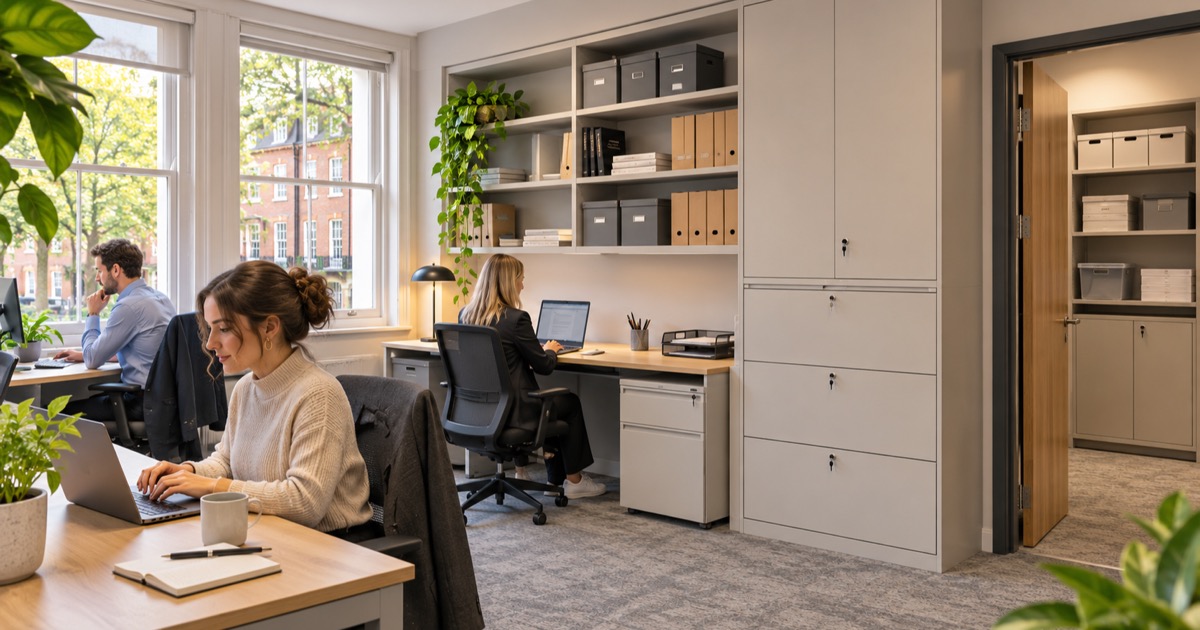
Can you find office space with storage in Dublin? Yes, but ask what kind of storage the exact office provides. A lockable cupboard inside a private suite, a shared locker, a dedicated store room and a separate storage unit solve different problems. Confirm the space, access, security, permitted contents and any extra charge before you compare offices.
Storage sounds like a small detail until it starts using desk space or slowing down the work. A consultancy may need a few secure filing cabinets. An events business may need room for cases and displays. A company handling stock may need deliveries and regular collections as well as shelves. The useful office is the one that fits the actual flow of things through the business.
Start with what you need to keep, and how often you need it
Before looking at listings, make a simple inventory. Separate things used daily from items touched once a month and material that is kept only for an occasional project. Count boxes, cabinets, equipment cases and consumables in real dimensions. A photograph of the current storage area is often more helpful to an office adviser than the phrase “a bit of storage”.
Then ask who needs access. A sales team collecting samples each morning needs storage close to the work area and an easy route to the street. Archived records may be accessed rarely but need controlled entry. Marketing materials may arrive in bulky deliveries and leave in smaller batches. These are different location and access questions, even if the items occupy the same amount of floor space.
Plan for the next year as well as today. Is the inventory shrinking as records move online, or does each new client add a physical kit? Will a move create temporary boxes that disappear after a month? Do not take a permanently larger office just to hold a one-off moving pile. Equally, do not assume a neat cupboard will absorb a business that is steadily adding stock.
What does “storage included” mean in an office listing?
It may mean furniture supplied with the office: desk pedestals, open shelves or a shared cupboard. It may mean a room inside the private office, a lockable cage elsewhere in the building or access to a separate unit. Ask the provider to show you the exact space attached to the office you might take. A photograph of another suite is not enough.
Look at usable dimensions rather than a label. Can cabinets open fully? Is there enough clearance to move a box without disturbing a workstation? Are shelves deep and strong enough for the items you actually use? Does the store room have lighting and a dry, suitable environment? A narrow alcove can be perfectly useful for files and hopeless for display cases.
Some Dublin operators describe lockable storage within an office, while others offer on-site storage separately. For example, Broombridge Business Centre describes flexible filing units and secure storage available on site, and U Store It describes office and storage space under one roof in North Dublin. These examples show the range of arrangements; they are not a promise that a particular room or unit is available for your move date. Confirm the current offer directly.
Inside the suite, elsewhere in the building, or off-site?
Storage inside the suite is convenient for material used throughout the day, but it competes with desks and meeting space. A separate room in the building can free the main office while keeping things close. Off-site storage may suit archives or seasonal items, provided someone has a workable retrieval process. The best answer depends on frequency, confidentiality and the cost of moving things, not only on square footage.
Do a normal working-day test. If a colleague must leave a meeting, pass reception, take a lift and find a building manager every time they need a sample, the arrangement may be too cumbersome. If an archive box is collected twice a year, those extra steps may be entirely reasonable. Convenience has a value, but only for items you actually use often.
Ask who can enter, lock and move the contents
“Lockable” does not explain who holds the keys or who else can access the area. On a viewing, ask whether storage sits inside your exclusive office, in a shared room or behind a building-managed door. Find out how access is issued, whether it is logged, what happens when a key or card is lost and whether staff can reach the space outside reception hours.
If the contents include personal information, discuss your own records policy with the people responsible for it. The Irish Data Protection Commission's security guidance highlights restricted access to files and secure disposal of paper records as physical-security considerations. A shared cupboard in a public corridor is a different proposition from a controlled cabinet inside your suite. Ask about the arrangements, then decide whether they meet your organisation's requirements.
Equipment needs a similar practical review. Can laptops, tools or demonstration devices be left overnight under the agreement? Is the room covered by the building's security arrangements, and what does your own insurance require? Ask the provider and your insurer rather than assuming that an office licence covers the contents. If items are particularly valuable or sensitive, make that part of the brief at the start.
The route from the delivery door matters
A room can have plenty of shelves and still be awkward for a business that receives deliveries. Walk the full path from the street to the storage space. Is there a loading place? Can a courier stop legally and safely? Are there steps, narrow doors or a small lift? Is reception willing and able to accept the type and volume of parcels you receive?
Ask when deliveries can arrive, who signs for them and where they wait before collection. A few small parcels may fit the building's normal mail routine. Regular pallets or bulky cases may not. If staff collect items after hours, check whether the building's access rules make that possible. A short conversation about an ordinary Tuesday can expose more than a general promise of “mail handling”.
Location across Dublin also changes the trade-off. A city-centre suite near clients and public transport may be excellent for a service team but difficult for frequent bulky deliveries. A North Dublin or suburban site may offer easier vehicle access or a separate unit, but lengthen the trip for staff or visitors. Map the actual journeys for people and goods before treating either location as the obvious choice.
Keep storage out of the wrong spaces
Boxes have a habit of migrating into meeting rooms, beside desks and eventually into circulation routes. That is usually a sign the storage plan is undersized or inconvenient. It also makes an otherwise good office feel smaller and less professional. Decide where new deliveries go, who clears them and how often older material is reviewed.
Do not plan to use an escape corridor as overflow storage. The Health and Safety Authority says workplace escape routes must be kept clear. Ask the building manager what can be stored in the proposed room, whether shelving or heavy equipment is permitted and whether any fire-safety conditions apply. The right answer is specific to the building and contents.
Sometimes the problem is not the size of the office at all. Old equipment, duplicate printed material and boxes nobody owns can consume useful space. A clear-out, scanning project or separate archive arrangement may be cheaper and more effective than renting another workroom. Make that decision before you pay for extra square footage month after month.
Compare the complete cost, not the cupboard
When two offices appear similar, ask for the storage terms in writing. Is a cabinet included with the furniture? Is the separate room exclusive to your business? Does an on-site unit have its own monthly fee, deposit, access charge or notice period? Can you add or reduce storage later without changing the office agreement?
Then compare alternatives on the same basis. One larger suite may hold everything but leave you paying for space that could otherwise seat people or host meetings. A smaller private office plus nearby storage may cost less, but add travel time and handling. An off-site archive is useful only if retrieval times suit your work. The right calculation includes staff time, delivery arrangements and any insurance or fit-out needs alongside the quoted rent.
For a serviced office, check whether the operator will permit your cabinets or shelving, or whether the suite must stay in its standard layout. In a managed or leased office, you may have more control over a store room, but fit-out, maintenance and reinstatement responsibilities can be different. Ask to see the actual licence or lease terms rather than relying on a headline comparison.
Take a storage brief to the viewing
A useful brief is concrete: “We need two lockable filing cabinets in our suite, space for ten sample cases, and reception to accept three or four small deliveries each week.” Add the largest item's dimensions, the people who need access, the busiest collection time and any security requirements. If you expect growth, say how quickly and in what form.
At each viewing, ask someone to show the storage area, the route from the entrance, the door and lift sizes, and the access procedure. Open a cabinet, measure a shelf if necessary and stand where the boxes would be placed. Ask what is included in the quote and request any extra storage charge in writing. It is easier to compare honest details than to remember a vague assurance afterwards.
Ping Offices can use that brief to compare Dublin office options and check with operators what is available now. Tell us the team size, preferred area, move date and what must be stored. We can help shortlist spaces that work for the people at the desks and the equipment behind them.
The right office does not necessarily have the largest store room. It gives everyday items a convenient home, protects sensitive or valuable material appropriately, and keeps deliveries and people moving without turning the workspace into a warehouse. Check those functions before the office makes your shortlist.
Common questions
Do serviced offices in Dublin include storage?
Some include cabinets or lockable space, while others offer a separate room or on-site unit for an additional charge. Ask about the exact suite, permitted contents, access hours and price. “Storage available” is not enough to establish what your business will get.
Should we rent a bigger office to store stock or files?
Only after comparing the full options. Frequently used items may justify space inside the office. Infrequent archives may work better elsewhere. Compare rent, retrieval time, delivery handling, security and the effect on desk or meeting space before choosing.
News insight
 Nov 19, 2026
Office Space Near Heuston Station Dublin: A Practical Guide
How to choose an office near Dublin Heuston Station, from the real walk to the station to team commu...
 Nov 17, 2026
Office Space with a Terrace in Dublin: What to Check
A practical guide to finding Dublin office space with a terrace or courtyard, including access, usab...
 Nov 12, 2026
Office Space with 24-Hour Access in Dublin: What to Check
Need a Dublin office you can use early, late or at weekends? Learn what to check about access, secur...
Thanks! We've got your request.
Our team will review your details and be in touch shortly with your personalised quote.