
Office Space with 24-Hour Access in Dublin: What to Check

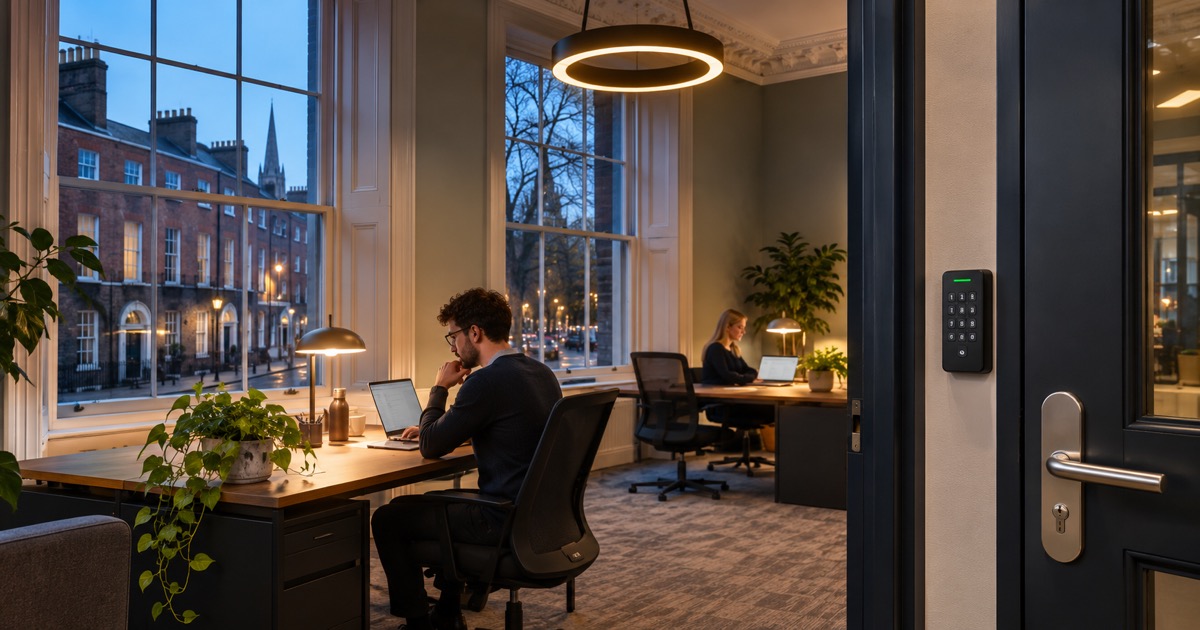
At eight in the evening, the office is a different place. Reception has gone home, the shared café is closed, and the front door that stood open during the viewing now needs a pass. If your team finishes client work late or starts before the city wakes up, those details matter more than the phrase “24-hour access” on a listing.
Can you get office space with 24-hour access in Dublin? Yes. Some Dublin serviced and private offices advertise access at any hour, but the exact arrangement varies by building and agreement. Check whether your team can enter the building and your own suite every day, which facilities remain usable, how visitors are handled, and whether there are extra rules or charges. A door that opens at midnight does not necessarily mean every service does.
For one business, late access is a useful contingency during a deadline. For another, it is part of the normal week: an international team taking early calls, a production crew working in shifts, or a founder who needs quiet time before colleagues arrive. The search becomes easier when you describe the actual pattern rather than simply ticking a 24/7 box.
First decide what “after hours” means for your team
Write down the times your team expects to use the office over a normal month. Is someone likely to arrive at seven on weekdays? Do two people work until ten on Thursdays? Would a Saturday visit be exceptional or routine? A provider can answer a specific use case much more clearly than a broad request for unrestricted access.
Separate staff access from guest access. A team member with an individual fob may be able to work late, while a client, freelancer or delivery driver cannot enter without someone meeting them. If you host evening workshops or occasional weekend meetings, ask about those events explicitly. They may be treated differently from an employee quietly using their desk.
There is also a difference between having the option and choosing a building around it. If late visits happen twice a year, a practical fallback may be enough. If several staff work outside conventional hours every week, make access, comfort and the journey home central to the shortlist.
Follow the route from the street to your desk
“24-hour access” can refer to the main entrance, the private office, or both. On a viewing, ask to see the exact route an employee would take outside staffed hours. Where is the entrance? Is a side door used at night? Do lifts still serve your floor? Does a pass open the suite as well as the building? Could a colleague who forgets a pass get help?
In a multi-tenant Dublin city-centre building, the daytime route through reception may differ from the evening one. A Georgian building may have a straightforward own-door entrance but narrow internal access; a larger block may use turnstiles, security gates and several lift banks. Neither format tells you enough on its own. Ask for a demonstration of the route your people would actually use.
If a colleague needs step-free access, check the after-hours route specifically. A lift, accessible entrance or assistance process that works during the day may depend on a staffed desk or another controlled door. The right question is whether the complete journey remains usable at the hours that matter to your team.
Ask what happens when the system fails
Access systems are easy to admire when they work. Ask whom staff call if a fob stops working, a phone app has no signal or a door fails to release. Is support available at the times you plan to work, or only the next business morning? Find out how new starters receive access and how permissions are removed when someone leaves. These small operational questions are part of the value of a well-run office.
Check which parts of the office remain usable
A private suite may be open all night while the shared meeting rooms, kitchen, showers or printers have separate opening hours. A reception team that accepts parcels during the day may not be present in the evening. If the building advertises a lounge or café, ask whether it is accessible, staffed or simply closed after a set time.
Think through a normal late shift. Will the heating or air conditioning run in your suite? Are the lights automatic or controlled by the team? Is the internet available and supported? Can someone make a drink, use a bathroom on the same floor and leave by a clearly marked route? The answers can vary even within one building.
For teams that make calls across time zones, privacy matters as much as entry. A phone booth or shared meeting room that closes at six will not help a nine o’clock client call. Ask whether calls can be taken comfortably in the exact space you would rent, and whether noise rules apply in the evening. If the office needs to host a late group meeting, confirm that the room booking policy allows it.
Treat security and lone working as real operating questions
Late access can be valuable without every employee working alone. Still, a person in an otherwise empty office should know how to leave safely, get help and respond to an emergency. Ireland’s Health and Safety Authority guidance on lone working says employers should assess the risks of working alone and plan suitable controls. The office provider’s building procedures and the employer’s own arrangements need to fit together.
Ask who monitors the building outside staffed hours, how an alarm is handled and whether security staff are on-site, on call or remote. Find out how a person inside the suite would raise an urgent issue, including illness, a locked exit or a building fault. Check that employees know the correct exit route, not just the door they used to enter.
These are sensible questions for any office, but they become sharper when the usual reception team is absent. Do not assume that a camera, a keypad or a concierge during daytime hours answers them. Describe your working pattern to the provider and ask for the actual procedure in writing.
The journey home is part of the decision
An office can work beautifully at nine in the morning and be awkward at eleven at night. Check the walk from the door to the transport your team would use. Is the route straightforward? Where would someone wait for a bus or taxi? If colleagues cycle or drive, can they reach the bike room or car park after the main entrance closes?
Dublin has late and 24-hour bus services on some routes, but coverage and timetables differ. Use Transport for Ireland’s current night-services information and journey planner to test each person’s likely trip at the time they would actually leave. Do not rely on the daytime journey shown during an office viewing.
Location choices can look different for a business that finishes late. A central address may shorten the walk to a relevant bus route; another area may be easier for a team whose members mostly drive. The answer depends on where people travel from and how often they make the journey, not on a general ranking of Dublin districts.
Read the access terms, not just the amenities list
Ask whether round-the-clock entry is included in the quoted office fee and whether it applies to every named team member. Some agreements may limit the number of passes, charge for replacements, require advance notice for events or set rules for guests. Extra heating, security, cleaning or meeting-room use may be treated separately. The only reliable answer is the written offer for the particular suite.
It is worth asking about public holidays and building works as well. Does the access arrangement apply every day of the year? What notice would the provider give if the entrance, lift or shared area had to close temporarily? If your business relies on a particular late shift, ask how that would be managed rather than assuming the word “24/7” covers every situation.
Do not pay for a premium feature without deciding how often it will be used. Equally, do not choose a cheaper office whose restricted hours would repeatedly interrupt work. Compare the total cost of the office against your real schedule, including any facilities that are unavailable when staff are there.
Test the promise during a viewing
Ask the operator to walk you through one concrete example: “Two colleagues arrive at 7 a.m. on a Wednesday and need to take a private video call at 7:30. How do they enter, reach the suite and use the facilities?” Then try another: “One person leaves at 10 p.m. on a Friday. Which exit do they use, and who can they call if there is a problem?”
Request the access policy, building hours, guest rules and any extra charges before you commit. If late access is central to the decision, consider a second visit near the time your team would use the space. The daytime tour shows the office at its easiest; the later visit shows whether the arrangement will work in practice.
There are Dublin providers that publicly describe 24-hour access, including The Office Suite in Swords and U Store It’s serviced offices. These examples confirm that the feature exists locally. They do not tell you which exact suite is available or what your agreement would include. Verify both points for each office on your shortlist.
Build a shortlist around the hours you actually keep
The best office with 24-hour access is the one that remains practical when the usual building team is gone. The door, desk, lighting, internet, shared facilities, safety procedure and journey home all need to make sense together. A good shortlist records those answers for each space instead of treating “24/7” as a simple yes-or-no feature.
Tell Ping Offices when your team normally arrives and leaves, how many people may work late, whether you host visitors after hours and which Dublin areas suit their journeys. We can help you compare Dublin office options and confirm the access arrangements for the specific spaces you are considering.
Common questions
Does 24-hour office access include meeting rooms and reception?
Not necessarily. A building may allow staff into their private suite at any hour while reception is staffed only during set times and shared meeting rooms have separate booking rules. Ask for the hours and charges for each facility.
Can clients visit an office after normal working hours?
That depends on the building’s guest and security policy. Some arrangements require a team member to meet and escort visitors, while others need advance registration or do not permit certain events. Confirm the process for the exact office before booking a late meeting.
News insight
 Nov 19, 2026
Office Space Near Heuston Station Dublin: A Practical Guide
How to choose an office near Dublin Heuston Station, from the real walk to the station to team commu...
 Nov 17, 2026
Office Space with a Terrace in Dublin: What to Check
A practical guide to finding Dublin office space with a terrace or courtyard, including access, usab...
 Nov 10, 2026
Office Space with Storage in Dublin: What to Check
Need a Dublin office with room for files, equipment or stock? Learn how to check storage size, acces...
Thanks! We've got your request.
Our team will review your details and be in touch shortly with your personalised quote.