
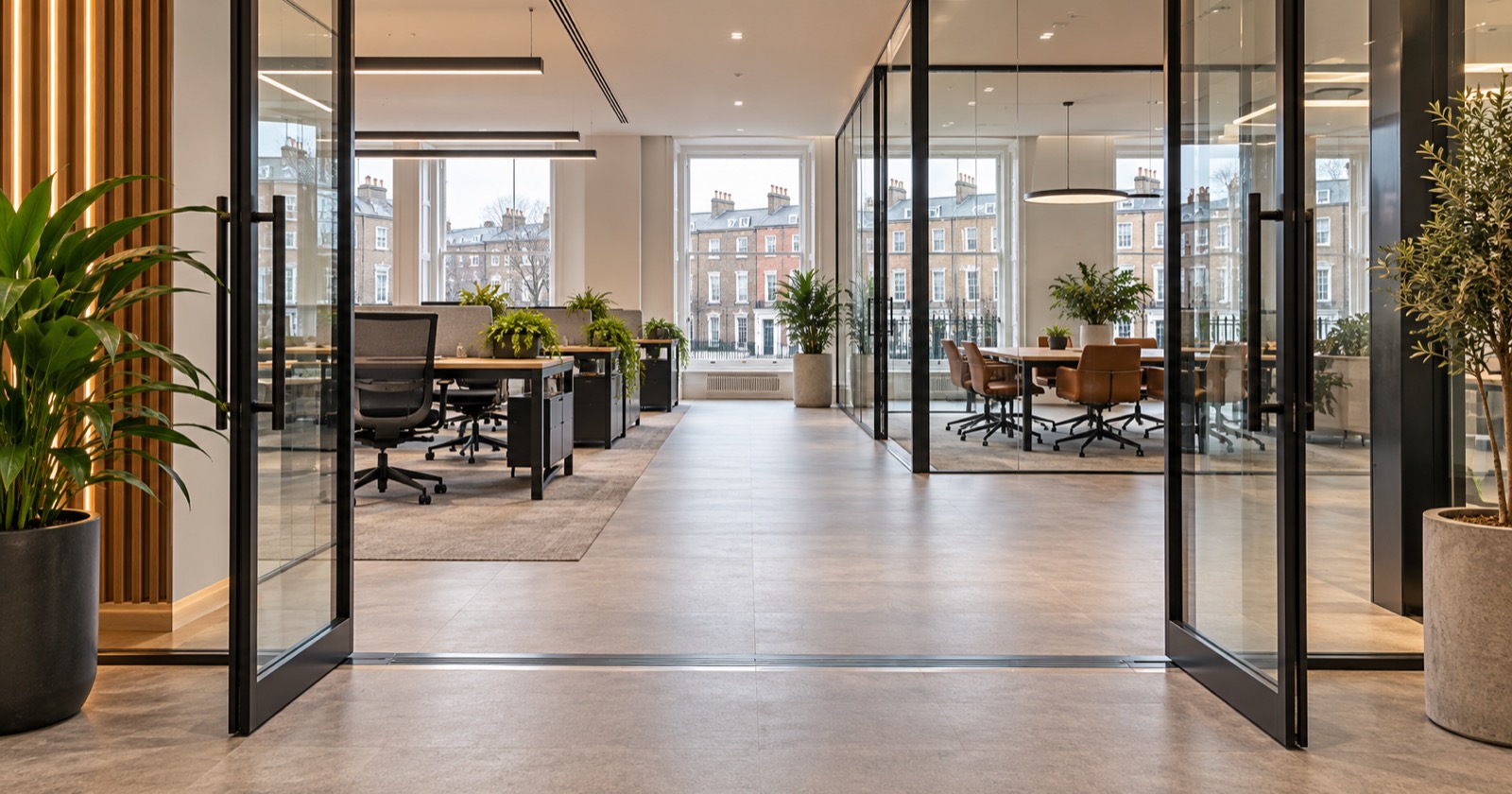
Accessible Office Space in Dublin

You find an office that looks right on paper: the location works, the meeting room is bright, and the brochure says the building is accessible. Then a colleague arrives for the viewing and discovers that the useful entrance is around the back, the lift does not reach the exact floor, or the accessible toilet is behind a locked door. A single feature on a listing cannot tell you whether the working day will work.
If you are looking for accessible office space in Dublin, assess the whole journey: from the stop, street or parking space to the entrance, reception, desk, meeting rooms, kitchen and toilets. Ask how that route works at the hours your team actually uses the office. The right answer depends on the people who will use the space, so treat a viewing as a practical test rather than a tick-box exercise.
What does “accessible” mean for this office?
An accessibility label is a starting point, not a specification. One building may have a level main entrance but a step into the private suite. Another may have a lift and an accessible toilet, while the only meeting room your team can book sits beyond a heavy door. The exact suite and the shared parts of the building both matter.
Start with the tasks people need to do there. Can everyone arrive independently? Reach a workstation? Join a client meeting? Use the kitchen and toilet? Leave safely? Include visitors and prospective colleagues, not only the current team. There is no single office feature that answers every need, and it is better to ask about a particular route or facility than to ask whether a building is “fully accessible”.
Ireland’s Centre for Excellence in Universal Design considers the approach, entrance, movement through a building, facilities and management as connected parts of access. That is a useful way to structure your viewing, even if you are not conducting a formal assessment.
Start the viewing before you reach the front door
In Dublin, “near a station” and “easy to get to” can mean different things. A route that is straightforward for one person may involve a difficult crossing, a long detour to a level entrance or an unreliable final stretch for someone else. Look at the route from the transport stop to the actual building door, not only the distance on a map.
Transport for Ireland provides accessibility information and journey-planning tools. Use them to plan a likely commute, then test the particular journey and stop that matter to your team. Check the pavement, crossings and entrance on the ground. Routes and services can change, so confirm the practical details for the days and times people will travel.
If someone drives or is dropped off, find out where the car can stop, how far the route is to the entrance and whether a suitable parking space is reserved or shared. Ask about the terms of any space before you count on it. Our guide to office space with parking in Dublin covers the difference between a parking claim and a usable arrangement.
Walk the route a colleague would use every day
At the building, begin where someone would normally arrive. Check whether the entrance is level, how the doors open, where the intercom sits and whether reception is staffed when people need it. If a separate step-free entrance is offered, use it on the viewing. Is it easy to find, available at normal arrival times and connected to the same secure route as the main entrance?
Continue all the way to the proposed suite. See the lift rather than accepting “there is a lift” as an answer. Which floors does it serve? Is there room to enter and turn? Are there thresholds, fire doors or narrow turns between the lift and the office? Walk into the exact rooms offered, because layouts differ even within one building.
Ask the operator to demonstrate access cards, door releases and any after-hours route. A door that works while an agent holds it open may be hard to use alone. Equally, a tidy corridor on viewing day may collect deliveries or furniture once the building is busy. Ask how circulation space is kept clear in everyday operation.
You do not need to make a technical judgement on the spot. If a dimension, door force or other detail is important, ask for measurements or an assessment from someone qualified. Record the specific question and the answer so you can compare offices fairly.
Test the working day, not just the entrance
The desk is only one part of office life. Follow a realistic day: arrive, get coffee, join a team call, meet a client, use the toilet and leave. Can colleagues move between these places without special arrangements each time? Is there enough room around the proposed desk layout and in shared rooms? Can the furniture be adjusted if the team changes?
Meeting rooms deserve particular attention. A room may have a wide doorway but little turning space once the table and chairs are in place. Check the route to it, the actual furniture arrangement and how booking works. If the room is on another floor, test that journey too. Our Dublin meeting-room guide explains other questions to ask about availability and use.
Look at the kitchen and toilets with the same care. Are they on the same floor? Are they available to your suite throughout the hours you expect to work? Does a key, code or booked access affect use? Ask how facilities are maintained and who resolves faults. A feature that exists but cannot be used reliably is a poor basis for an office decision.
Accessibility also reaches beyond physical movement. Noise, lighting, wayfinding, signage and the way reception communicates can affect the day. Ask the people who will use the space which practical conditions matter to them; avoid guessing from a diagnosis or asking them to disclose more personal information than necessary to plan a suitable workplace.
Check access after hours and in an emergency
A serviced office can feel quite different once reception closes. If your team works early, late or at weekends, repeat the route in your mind without staff assistance. Which entrance is open? How are visitors admitted? Is the lift available? Who answers if an access control system fails? Ask for the actual operating procedure, not a general assurance.
Emergency arrangements need the same specificity. Ask the operator how the building’s evacuation plan covers the proposed suite and its occupants, and what responsibilities sit with the tenant. The Health and Safety Authority’s workplace guidance highlights safe circulation and emergency considerations. A viewing cannot certify a building or replace professional advice, so have the relevant arrangements reviewed where your team’s circumstances require it.
If an alternative route, assistance or piece of equipment is part of the answer, establish who provides it, how it is maintained and what happens when that person or device is unavailable. A good plan should survive an ordinary busy Tuesday, not depend on everyone remembering an informal workaround.
Put the important answers in writing
Before you commit, make a short record for each shortlisted office. Identify the exact suite and floor; the entrances and facilities you saw; any measurements or plans you still need; the operating hours; and the person who confirmed each point. If alterations are proposed, ask what work will be done, by whom, at whose cost and by what date. Check that any essential arrangement will continue for the period you expect to occupy the office.
This is particularly useful when comparing a modern fitted office with a character building in the city centre. Neither style tells you the whole answer. A central address might offer an excellent transport choice but a complicated internal route; a newer building might be easy to enter yet poorly arranged for the actual team. The viewing notes let you judge the space people will use, rather than the impression left by photographs.
A practical brief helps an office search move faster. Tell your adviser the preferred Dublin areas, team size, move date and must-have access features. Describe the route or facility needed in functional terms. You can then screen out unsuitable spaces before arranging viewings and use the visit to confirm, rather than discover, the basics.
Choose an office that works on an ordinary day
The strongest accessible office is not necessarily the one with the longest list of advertised features. It is the one where your team can get in, work, meet, use shared facilities and leave with confidence. Ask specific questions, walk the full route and verify anything critical before signing.
Browse Dublin office spaces or contact Ping Offices with your preferred area, team size and access requirements. We can help you shortlist suitable options and put the right questions to operators before a viewing. Availability and individual access arrangements should always be confirmed for the exact office you are considering.
Quick questions
Does a lift make an office accessible?
A lift is one part of the route. Check the entrance, route to the lift, the lift itself, route to the exact suite and access to the working and shared facilities.
What should I ask before viewing an office?
Ask for the exact suite and floor, the step-free arrival route, lift access where needed, usable toilets and meeting rooms, access hours and any measurements or arrangements essential to your team.
Can accessibility be confirmed from a listing?
No. A listing helps you shortlist, but the practical route and facilities should be checked in the exact building and suite, with important answers confirmed in writing.
News insight
 Oct 22, 2026
Using AI to Find Office Space in Dublin: What to Ask and What to Check
Use AI to research office space in Dublin and Ireland. Learn what to ask, how to compare options, an...
 Oct 22, 2026
Office Space with Phone Booths in Dublin
A practical guide to judging Dublin office phone booths for private calls, video meetings and a team...
 Oct 15, 2026
Office Space with a Kitchen in Dublin: What to Check
Looking for office space with a kitchen in Dublin? Learn how to compare shared kitchens, private kit...
Thanks! We've got your request.
Our team will review your details and be in touch shortly with your personalised quote.