
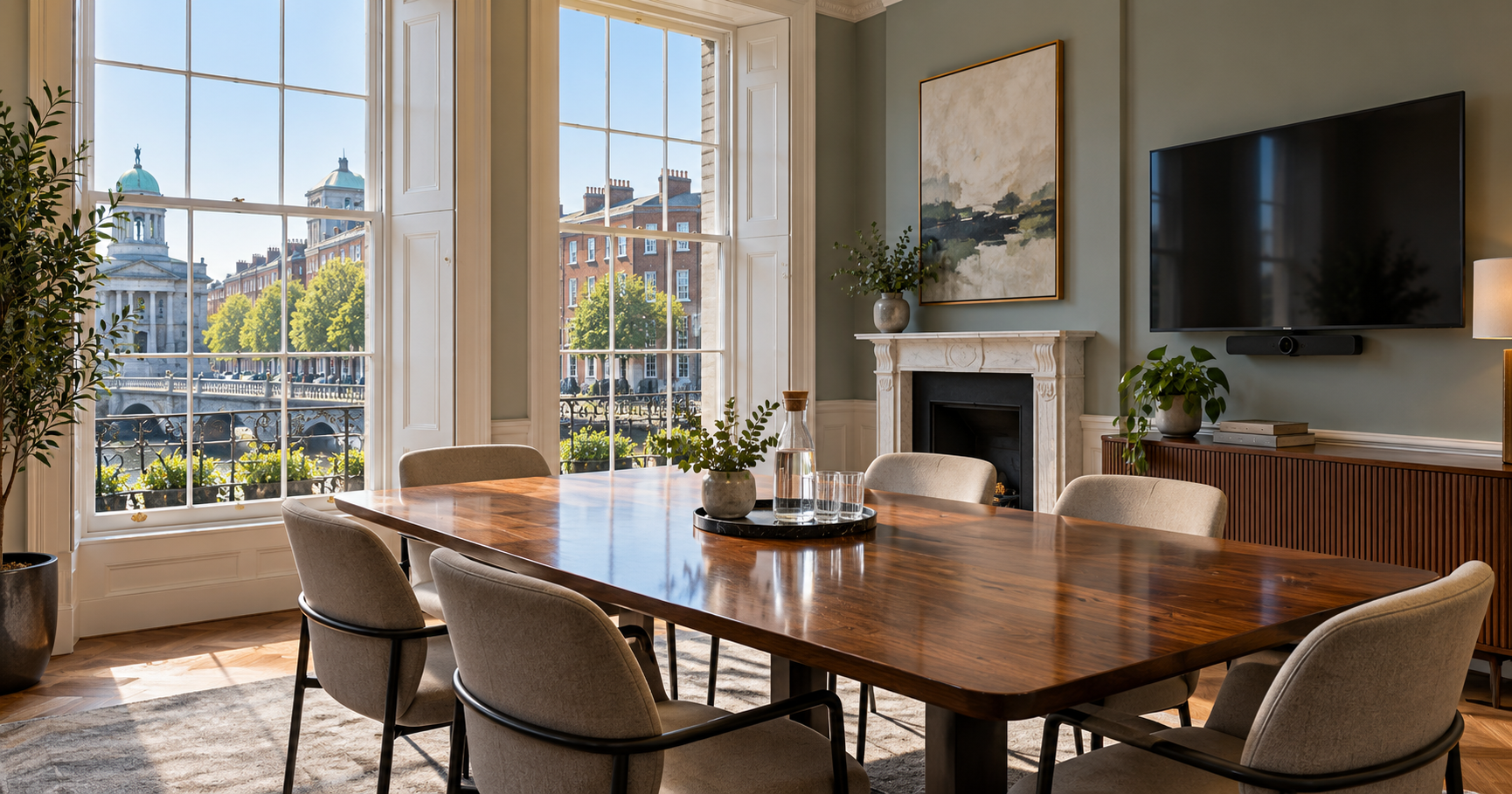
Office Space with Meeting Rooms in Dublin: What to Check Before Signing

You find a Dublin office that seems to solve the main problem: the right number of desks, a sensible location and a room where clients can meet the team. On the viewing, someone points towards a smart boardroom. It is easy to picture the next pitch there. What is less obvious is whether that room belongs to your office, whether you can book it on a Tuesday morning, and what using it every week will cost.
If you are looking for office space with meeting rooms in Dublin, start by separating three things: a meeting room inside your private office, access to shared rooms in the building, and meeting-room hours included in your agreement. They are different propositions. The right choice depends on how often your team meets, who attends, how confidential the conversations are and when the room is needed.
A good office search therefore begins with your calendar, not the photograph of a boardroom. Here is how to turn that calendar into a brief you can actually use.
What does “office with meeting rooms” actually mean?
In Dublin listings, the phrase can describe quite different arrangements. A private suite may have its own enclosed meeting room behind your door. A serviced office may give occupiers access to several shared rooms elsewhere in the building. A smaller office might have no formal meeting room at all, but let you book one when you need it. Some buildings combine these options.
The distinction matters because a room you control is available whenever your office is open. A shared room may be larger and better equipped, but its usefulness depends on the booking system, other occupiers and the hours you are allowed to use it. “Meeting rooms available” is a useful starting point for a listing; it is not a complete answer to the operational question.
Ask the agent or operator to identify the exact rooms you can use, where they are, how they are booked and which charges apply. Get that answer for the specific office you are considering, rather than assuming every suite in the building has the same access.
Let your busiest working day set the brief
Imagine a twelve-person team that is in the office together on Tuesdays and Thursdays. There is a weekly leadership meeting, two client calls and an interview on the same afternoon. A boardroom used once a month would be easy to arrange. Three conversations at once are a different problem.
Look at the next month of your calendar. Count recurring team meetings, client visits, interviews, training sessions and confidential calls. Note the days and times when they overlap. This will show whether you need one large room, two smaller rooms, or a mix of bookable meeting space and phone booths. If the business is growing, include the meetings you expect six months from now, while avoiding a speculative brief based on every possible future use.
For a team with occasional external meetings, a small private office with reliable shared meeting rooms may be the more practical fit. If several people need private conversations every day, a dedicated internal room can remove a great deal of friction. The question is not simply how many desks fit, but how the team actually works between those desks.
Dedicated room or shared booking?
A dedicated room gives your team control. You can leave a project on the screen, move quickly from a call into a discussion and avoid competing for a slot. That can be valuable for client-facing teams, leadership groups and work involving sensitive material. The trade-off is that the room takes up space within the suite and may affect the overall office cost. Check that it is genuinely separate from the desk area, with appropriate doors and acoustic privacy.
A shared room makes sense when meetings are less frequent or vary widely in size. You might book a two-person room for interviews and a larger boardroom for a quarterly presentation. The key test is real availability at the times you need it. Ask for a demonstration of the booking process and how far ahead you can reserve. Find out whether regular slots can be held, how cancellations work and whether another occupier can extend into your booking.
There is also a middle ground: a private office with a small internal meeting space and access to larger shared rooms. For some Dublin teams, that combination handles everyday conversations without paying for a large boardroom that sits empty most of the week.
Check capacity as people actually sit
A room advertised for eight may comfortably seat eight for a short meeting but feel tight when laptops, documents and a camera are in use. Ask to see the layout with the table and chairs that will remain in place. Sit where a visitor would sit. Can everyone see the screen? Is there enough room to move around the table? Can a wheelchair user enter, turn and participate comfortably if accessible space is part of your brief?
Shape matters too. A long boardroom table works for a formal client presentation, while a smaller round table may be better for collaborative work. A training session needs a different layout again. If the listing promises flexible room configurations, ask who rearranges the furniture and how much notice is required.
For hybrid meetings, check that remote participants can hear voices from the far end of the table. A good-looking screen alone does not make a room useful for a call. Try a live connection during the viewing if the technology is important to your business.
Privacy is more than a closed door
In a client meeting, what happens just outside the room can matter as much as what happens inside it. Is the room beside a busy shared kitchen? Can people in the corridor hear a conversation? Can visitors reach reception and the meeting room without walking through your team's work area? These details affect both confidentiality and the impression you give guests.
Walk the route a visitor would take from the building entrance. Check reception hours, visitor sign-in, lift access and whether guests need to be escorted. If you hold regulated or otherwise sensitive discussions, state the requirement clearly before a shortlist is made. Do not rely on a photograph to judge acoustic privacy or access arrangements.
Consider where quick calls go as well. A formal meeting room should not become the only quiet place in the building because all the phone booths are occupied. The best arrangement often includes several levels of privacy: a booth for one person, a small room for two or three, and a larger space for clients or the full team.
Understand the full meeting-room cost
Meeting-room access may be included in an office fee, provided through a monthly allowance, discounted for occupiers, or charged by the hour. Ask which model applies to the exact office and get the answer in writing. “Included” may still be limited to certain rooms, times or monthly hours.
Build a simple comparison using your normal meeting pattern. If you expect six hours of client meetings each week, calculate how much of that would be covered and what the remaining hours would cost. Add any charges for catering, equipment, evening access or extended bookings that you would genuinely use. This gives you a more useful picture than comparing office rent alone.
Our guide to what is included in a serviced office price explains the wider monthly-cost question. For this decision, the point is narrower: check whether the meeting facilities you expect to use are available on terms that suit your working week.
Location matters for the people coming to meet you
A meeting room can be excellent and still be awkward for the people who need to reach it. Think about where your clients and colleagues travel from. For a team meeting visitors across the city, proximity to a DART or Luas stop may be more useful than a particular postcode. For regional visitors, connections from the station or airport may shape the shortlist. If people drive, ask about visitor parking rather than assuming staff parking covers guests.
Look at the final part of the journey too. Is the building easy to find? Is there a clear entrance and a staffed reception? Is the route accessible for the visitors you expect? A client should not need a long set of directions to find the room. If parking is important, our guide to office space with parking in Dublin covers the questions to ask about bays and access.
These are practical considerations, not reasons to choose the most expensive address. The right Dublin location is the one that works for your team's regular commute and the visitors who use the space.
What to do on the viewing
Before the viewing, send a short meeting brief alongside your desk count and move date. State how many people need to meet at once, the largest meeting you hold regularly, whether clients attend, and whether private calls are frequent. That gives the person showing you around a chance to identify a real solution instead of pointing out the most impressive room.
At the property, visit the exact office and the rooms your agreement would let you use. Ask to see the booking system, test the screen and audio if relevant, and check the route from reception. If a room is busy during the viewing, that can be helpful information: ask when it tends to be busiest and whether there are alternatives in the building.
Afterwards, request a written summary of the room access, included hours, additional charges, booking rules and any restrictions on external guests. Do the same for two or three shortlisted offices so you can compare them on like terms. You may discover that a slightly smaller suite with dependable shared rooms works better than a larger one with an internal room you rarely use.
Choose for the meetings you will actually hold
There is no single best type of Dublin office with meeting rooms. A consultancy with frequent confidential client conversations may place a high value on its own room. A small team that meets clients twice a month may prefer a well-run shared facility. A growing company may need an internal space for everyday work plus a larger bookable room for presentations.
Start with the calendar, then verify the rooms, the rules and the total cost. That sequence turns a broad online search into a shortlist that reflects how your business operates. It also makes the viewing more useful: you can ask whether a particular office solves a real problem, rather than whether the building has a boardroom somewhere.
Browse Dublin office options, or tell Ping Offices your team size, preferred area, move date and meeting pattern. We can help identify suitable offices and confirm the meeting-room arrangements before you commit time to viewings.
Common questions
Are meeting rooms included with a serviced office in Dublin?
Access is common, but the allowance varies by building and agreement. Some offices include a number of hours; others charge per booking. Confirm the exact rooms, hours and rates for the office you are considering.
Do I need a dedicated meeting room inside my office?
It is worth considering if your team has frequent, overlapping or confidential meetings. For occasional meetings, reliable shared rooms may be enough. Your calendar and the building's booking rules will tell you more than the headline desk count.
What should I ask before signing?
Ask which rooms you can use, how far ahead you can book, whether hours are included, what extra use costs, how visitors enter, and whether the technology and acoustic privacy meet your needs. Have the answers recorded in the proposed terms.
News insight
 Sep 29, 2026
Office Space with Parking in Dublin
Looking for office space with parking in Dublin? Learn what to check about spaces, costs, visitor ac...
 Sep 28, 2026
Live Office Availability in Dublin: Find Space You Can Actually View
Looking for office space available in Dublin now? Learn how to check live options, compare move-in d...

Thanks! We've got your request.
Our team will review your details and be in touch shortly with your personalised quote.