
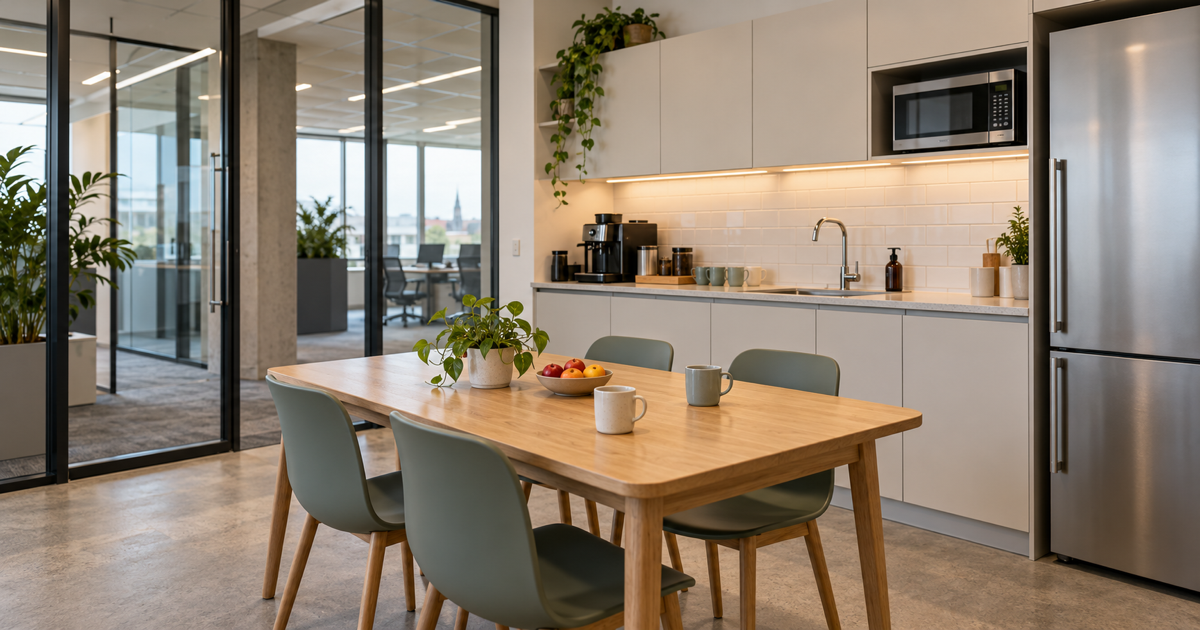
Office Space with a Kitchen in Dublin: What to Check

The listing says “kitchen facilities”. On a viewing, your team discovers a coffee machine in a corridor, a fridge shared by three floors and nowhere four colleagues can sit down together. The office itself may be excellent. The question is whether the kitchen arrangement will work on an ordinary Tuesday, when everyone arrives with lunch, a visitor needs a drink and someone wants ten quiet minutes away from their desk.
If you are looking for office space with a kitchen in Dublin, ask whether the facility is private to your suite or shared, what equipment and seating are actually available, who may use it, when it is accessible and which services are included in the agreement. See the exact room rather than relying on an amenities icon. A good kitchen need not be large or elaborate. It does need to suit the number of people who will use it.
This is a different decision from whether a serviced office has refreshments somewhere in the building. For some small teams, a well-managed shared kitchen is ideal. For others, a private kitchenette changes how the office functions. The right answer comes from your working day, not from the phrase in the advert.
What does “kitchen” mean in a Dublin office listing?
The word can describe several arrangements. A shared tea point may offer a sink, kettle and coffee machine but little room to prepare or eat food. A communal kitchen may add a fridge, microwave, dishwasher and tables, although the space is used by other occupiers. A private kitchenette sits inside your office or on a self-contained floor and is reserved for your team. A building café or restaurant is another amenity altogether: useful, but it does not answer where staff can store or heat their own lunch.
Dublin providers offer real examples at both ends. Some small serviced suites are marketed with communal canteen facilities, while larger self-contained floors can include a private kitchen. That variation is why “kitchen included” is too broad a filter on its own. Ask which of these arrangements applies to the particular suite being offered, not another office in the same building.
It also helps to separate an everyday office kitchen from a commercial food-preparation space. If your business intends to cook for sale or operate a food enterprise, an ordinary office kitchenette is unlikely to answer that brief. Tell the agent or operator about that use at the outset so the property, permissions and facilities can be assessed properly.
Start with your busiest lunch hour
Imagine the busiest normal day in the office. How many people bring lunch? How many buy something nearby and return to eat? Do colleagues take breaks at the same time, or in turns? Will visitors need tea and coffee? If most of a six-person team attends on Tuesdays and Thursdays, judge the kitchen on those days rather than on a quiet Monday viewing.
For a small team that mostly buys lunch out, a clean shared kitchen with a reliable fridge and a few seats may be enough. Another team may prepare food at home, store lunches, make coffee throughout the day and use the kitchen as its only informal gathering place. The same facility can be generous for one group and frustrating for the other.
The seating matters as much as the appliances. If the advertised “breakout area” doubles as a busy circulation route or an impromptu meeting spot, staff may end up eating at their desks. Walk from the office to the kitchen and sit down. Notice the noise, privacy and whether the room feels like a place where people can actually pause. The Health and Safety Authority’s workplace guidance distinguishes rest facilities from the work itself; in an office, the practical question is whether people can relax during breaks in the space available.
Shared kitchen or private kitchenette?
A shared kitchen can be a sensible use of space. Your team gains access to equipment and seating without giving up part of its own office for cupboards and appliances. In a well-run building, cleaning, supplies and maintenance may be handled centrally. It can also become a pleasant place to meet neighbours, though that is a bonus rather than a reason to overlook a shortage of seating or storage.
The trade-off is control. Other occupiers may arrive at the same time, use the fridge or book adjacent communal space for events. Ask how many people share the kitchen, whether access changes outside reception hours and who deals with an overflowing fridge or a broken machine. A viewing at 11 a.m. may not reveal the queue at 1 p.m.; if kitchen access is central to your decision, ask to see it around a normal break time.
A private kitchenette offers more predictability. Your team can set its own routine, keep supplies together and make refreshments for visitors without leaving its floor. It may matter for an office that hosts frequent client meetings or needs a quiet, controlled environment. But a private kitchen takes floor area, and the agreement may leave more cleaning, stocking or maintenance with your business. Do not assume “private office” means a private kitchen: the two are often separate parts of the offer.
There is a middle ground. Some managed offices or larger serviced suites give a team dedicated space within a building that also has shared facilities. If the office suits your headcount, ask whether a private kitchenette is already fitted, can be added with consent, or is available only in a different suite. Get any proposed alteration and its cost confirmed before comparing options.
What to check during the viewing
Open the fridge, look at the worktop and count the seats. These small actions answer more than an amenities list. Is there enough cold storage for the team that will attend together? Is there a microwave, a sink and a sensible place to wash or load dishes? Are mugs and basic supplies provided, or would you bring your own? If coffee is advertised, ask whether it means a machine available all day, a staffed counter at set hours or simply a kettle.
Then check the route. Is the kitchen close enough to use regularly, or across a reception area and another floor? Can staff reach it before or after standard hours? Is it accessible for everyone on the team? A kitchenette that looks adequate on a floorplan may be awkward if someone has to carry food through a client-facing room or wait for a lift each time.
Pay attention to the less photogenic details: ventilation, bins, cleaning and repairs. Ask who empties waste, how often surfaces are cleaned and whom to contact when equipment fails. If the team expects to bring in hot food, ask what the building permits. Some office kitchens are designed for reheating and drinks, not full cooking. A good operator should be able to explain the rules clearly.
A useful question to put to the operator
“Can you show me the exact kitchen our team would use on our busiest office day?” Follow it with: who else uses it, what is included, what are the access hours, and what happens if the equipment is out of service? The answer should relate to the suite you are viewing. A photograph of another floor is a starting point, not confirmation.
Read the cost and access terms together
A kitchen may be available without every associated service being included. Tea and coffee might be complimentary, stocked for a fee or supplied by tenants. Cleaning may cover communal areas but not the inside of a private suite. Some buildings provide crockery; others expect your team to bring it. Ask about guests, events, catering deliveries and any restrictions on equipment you may bring in.
Put these answers beside the total office cost rather than treating the kitchen as a free extra. An office with a private kitchenette may be more attractive, but only if the full space, term and cost suit the business. An office with an excellent shared kitchen can be the better choice if it leaves more usable room for desks and meeting space. Our guide to what is included in a serviced office price explains why apparently similar monthly quotes need to be compared line by line.
If you are choosing between city-centre and outer Dublin locations, resist assumptions about the kitchen based on the address. A converted Georgian building may have an appealing small tea point but limited dining space; a modern centre may offer a larger communal area. Equally, neither building style guarantees a better day-to-day setup. The exact suite, occupancy and operator’s rules decide what your team receives.
Build a shortlist around how the team works
Before searching, give the kitchen requirement a plain description. “Six desks, four people in together most days, fridge and microwave essential, somewhere to eat away from the desks, shared space acceptable” is far more useful than “must have kitchen”. If privacy matters, say so. If visitors need refreshments near a meeting room, mention that too. It helps to rank those needs beside location, commute, move date and budget.
For each candidate, record the exact kitchen arrangement in one sentence: private or shared, floor, seating, appliances, hours and any extra cost. A short comparison will make the decision clearer for colleagues who did not attend the viewing. It also prevents a good office from winning on a photograph while an everyday inconvenience goes unnoticed.
Ping Offices can help you compare Dublin office options and ask providers about the particular kitchen your team would use. Tell us your busiest-day headcount, preferred area, move date and what matters most at lunch or when hosting visitors. We can help build a shortlist that works beyond the viewing.
Questions people ask about Dublin office kitchens
Do serviced offices in Dublin have kitchens?
Many offer kitchen or canteen facilities, but the arrangement varies by building and suite. It may be a shared tea point, a larger communal kitchen or a private kitchenette. Check the exact facility, equipment, seating, access and inclusions before treating it as part of the offer.
Can a small team get a private kitchen?
Possibly, but do not assume it comes with every private office. Ask whether the suite has its own kitchenette, whether an alteration is allowed, and how much usable office area it would take. A good shared kitchen may suit a smaller team better.
Does “kitchen included” mean we can cook meals?
No. Confirm what equipment is provided and what food preparation the operator permits. Many office facilities are intended for drinks, storage and reheating. If cooking is essential to your business, describe the intended use before viewing.
News insight
 Oct 22, 2026
Using AI to Find Office Space in Dublin: What to Ask and What to Check
Use AI to research office space in Dublin and Ireland. Learn what to ask, how to compare options, an...
 Oct 22, 2026
Office Space with Phone Booths in Dublin
A practical guide to judging Dublin office phone booths for private calls, video meetings and a team...
 Oct 20, 2026
Accessible Office Space in Dublin
A practical guide to assessing accessible office space in Dublin, from the journey and entrance to d...
Thanks! We've got your request.
Our team will review your details and be in touch shortly with your personalised quote.