

How Much Office Space Does a Hybrid Team Actually Need?

“We have 20 people, so should we be viewing 20-desk offices?” It sounds like a sensible brief until someone asks what happens on Wednesday. Twelve people might be in most mornings, yet a product meeting brings nearly everyone together once a week. The smaller office looks efficient on paper and uncomfortable in practice.
How much office space does a hybrid team need? Start with the number of people who must work in the office at the same time on a normal busy day, then test whether that space also handles meetings, private calls, visitors and likely growth. Headcount and weekly average attendance are useful context, but neither is a reliable desk requirement on its own.
This is a practical exercise for a Dublin business considering a move, a renewal or its first private office. There is no universal desks-per-person figure that will fit every hybrid team. The right number follows the way your colleagues use the office and the type of building you choose.
Why the average day gives the wrong answer
Hybrid attendance is rarely even across a week. Teams often coordinate around shared days for meetings, training and decisions. A survey of Dublin city office users commissioned by Dublin City Council and reported by CBRE Ireland found that average office attendance across the working week was 50%, while Wednesday attendance reached 61% among the companies surveyed. Those figures describe that survey, not a target for your business. They show why a weekly average can conceal a busy-day squeeze.
Imagine a team with 20 staff members. If ten are in on an average day but 16 routinely arrive on Wednesday, ten desks are plainly insufficient. Equally, booking a desk for every employee may be unnecessary if the team never overlaps fully and has a sensible plan for exceptional all-hands days. You need the actual pattern, not a neat ratio lifted from another company.
There is a human cost to getting it wrong. On the crowded day, people arrive wondering whether they will find a place to work. Calls spill into corridors; a meeting room becomes an overflow desk area. On quiet days, rows of empty desks make an expensive office feel oddly lifeless. The aim is a workplace that functions well across both conditions.
Measure the busiest repeatable day
Begin with four to eight representative weeks of attendance if you have them. Count how many people were physically present each day, not how many were expected to come in. Note holidays, exceptional events and team-wide gatherings separately. A one-off annual meeting should not automatically set the permanent desk count; a full Wednesday that happens every week probably should.
If you do not have reliable attendance data, ask each team lead about the next month rather than relying on a company-wide guess. Which days do their people overlap? Are there roles that must be on site daily? Does the sales team return to the office after client visits? What happens when a new starter joins? A shared calendar or a simple desk-booking trial can reveal patterns before you commit to a new agreement.
Take the busiest repeatable day as your starting desk number. Then ask whether it needs a modest buffer for imminent hires, visitors who work alongside the team or attendance that is rising. A buffer is a business choice, not a fixed percentage. Write down the reason for each extra desk so you can defend the brief when comparing quotes.
A worked example, not a market rule
Suppose a fictional 20-person Dublin team records peak attendance of 15, 16, 15 and 16 people across four ordinary weeks. Two roles use fixed equipment, and one hire is due shortly. That team could begin viewing offices around 17 workstations, then test whether a smaller or larger layout works once meeting rooms and shared facilities are considered. The example explains the method; it is not a claim that every 20-person company needs 17 desks.
Now change one detail: the whole team meets in person every second Tuesday and wants to stay for a full working day. A 17-desk office may create friction unless there are genuinely usable overflow work points or a larger room where colleagues can work comfortably. The business must decide whether to accommodate that regular peak, stagger attendance or change the meeting routine. The space decision follows the operating decision.
Decide who needs an assigned desk
Desk sharing can work when people have suitable laptops, storage and a clear way to find a workspace. It is less simple for a colleague who needs specialist screens, accessibility adjustments or a confidential setup. Ask those people what they need before treating every desk as interchangeable.
For the rest of the team, decide how seats will be used on busy days. Will colleagues book them in advance? Can teams sit near one another when they need to collaborate? Who resolves a clash? A beautiful office with an unclear desk system can feel smaller than a modest one with a reliable routine.
Do not count a kitchen stool or a soft chair in a breakout area as a workstation unless someone can comfortably spend the intended amount of time working there. Test power, Wi-Fi, screen use, acoustics and posture. A lounge may be excellent for a short discussion and poor for a full afternoon of focused work.
Plan the rooms around what happens on a busy day
The number of desks is only one part of the brief. Picture the same busy Wednesday at 11 a.m. How many video calls are taking place? Is a manager holding a one-to-one? Are clients in a meeting room? Is another group trying to discuss a project at the desks? If every activity competes for one open floor, a lower desk count will not make the office work.
Map the activities that happen simultaneously. A team that spends much of its office day collaborating may value a good meeting room more than several spare desks. A confidential advisory practice might need quiet rooms and separation. A sales team may need phone booths or small call spaces. Our guides to meeting rooms and phone booths in Dublin offices explain what to check when those facilities are central to your week.
In a serviced office, some rooms may be shared with other occupiers. That can be economical if they are available when you need them. Ask for the booking rules, included credits, additional charges and actual availability on your busy day. A shared boardroom that is booked out every Wednesday does not solve your Wednesday problem.
Turn desks into a realistic office shortlist
Office listings may describe capacity as “up to 20 desks”, but that tells you little about the room once furniture, circulation and storage are in place. Ask for a floor plan and a proposed layout. During a viewing, stand where a workstation would go and imagine a normal call, someone walking past and a colleague opening a drawer. A room that fits 20 desks in a diagram may be much more comfortable with fewer.
Check the facilities that support your peak attendance: toilets, kitchen, lifts, access control and places to wait or meet. A 16-desk suite in a building with generous shared areas can behave differently from an isolated suite of the same stated capacity. Compare the whole arrangement, including the rules and charges attached to the shared space.
Dublin location affects attendance too. An office near the transport routes your team actually uses may make shared days easier to organise. A smaller space in the right place can be more useful than a larger one with a difficult commute. Map where colleagues travel from, then compare realistic routes by DART, Luas, bus, bike and car instead of relying on a postcode alone.
For each shortlisted office, take your peak-day plan into the viewing. Ask where 16 people would sit, where two simultaneous calls would happen, and where the team would gather. If the answer relies on a room that is not included in the price, add its likely use to the comparison. You are buying a working pattern, not just a row of desks.
Allow for change without paying for empty space now
Hybrid routines and hiring plans can change during an office agreement. Before signing, ask whether a larger suite might be available in the same building, whether adjacent space can be added, and how much notice either option would require. Do not assume an expansion option exists because another floor looks quiet today; get any important commitment into the agreement.
Also test the other direction. If attendance falls, can you reduce your footprint at a break point or move to a smaller suite? The flexibility of a licence or lease depends on its actual terms. Compare term length, notice, deposits and potential move costs alongside the monthly fee. Our guide on negotiating a Dublin office deal covers the wider discussion.
A staged solution can be sensible. Some teams take a private office sized for regular demand and use bookable meeting rooms or day space for occasional peaks. Others need all staff in one private suite because confidentiality or daily equipment makes spillover impractical. Neither approach is inherently cheaper once the full pattern and extra charges are considered.
What to send an office adviser before you view
A clear brief saves time. Share your total headcount, actual attendance by weekday, busiest repeatable day, fixed-desk needs, number of simultaneous calls, meeting-room use, expected hires, preferred Dublin areas and move date. Add any must-have accessibility, storage, client or security requirements. If the numbers are uncertain, say so; a short trial can be more valuable than false precision.
Ping Offices can use that brief to compare current office options, confirm what each provider includes and arrange viewings around the way your team works. We can also check live availability before you spend time on a space that cannot meet your date or desk needs.
The useful answer to “How much office space do we need?” is therefore a small set of tested requirements: enough real workstations for the normal peak, the right rooms for simultaneous activity, and terms that leave room for plausible change. Start with evidence from your own week, then let the office shortlist prove it can handle that week.
Common questions
Does a 20-person hybrid team need 20 desks?
Sometimes, but not automatically. Count the people who must work on site together on a normal busy day, account for fixed-desk roles and imminent hires, and test whether meeting and call space still works. A desk ratio without your attendance pattern is only a guess.
Should we size the office for our busiest ever day?
Usually the better starting point is the busiest repeatable day. Deal separately with rare all-hands events: you may use bookable space, stagger activities or choose a larger suite if those events require a full working day together.
News insight
 Oct 29, 2026
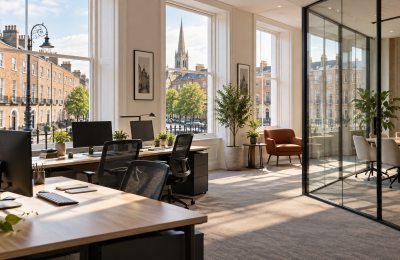
Is Now a Good Time to Negotiate an Office Deal in Dublin?
Dublin’s office market has shifted in favour of occupiers. Here’s what you can negotiate on serviced...
 Oct 22, 2026
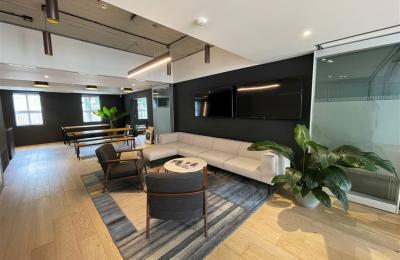
Using AI to Find Office Space in Dublin: What to Ask and What to Check
Use AI to research office space in Dublin and Ireland. Learn what to ask, how to compare options, an...
 Oct 22, 2026
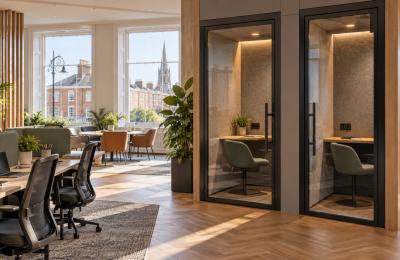
Office Space with Phone Booths in Dublin
A practical guide to judging Dublin office phone booths for private calls, video meetings and a team...
Thanks! We've got your request.
Our team will review your details and be in touch shortly with your personalised quote.